
NYC Home Inspection Guide for Older Houses
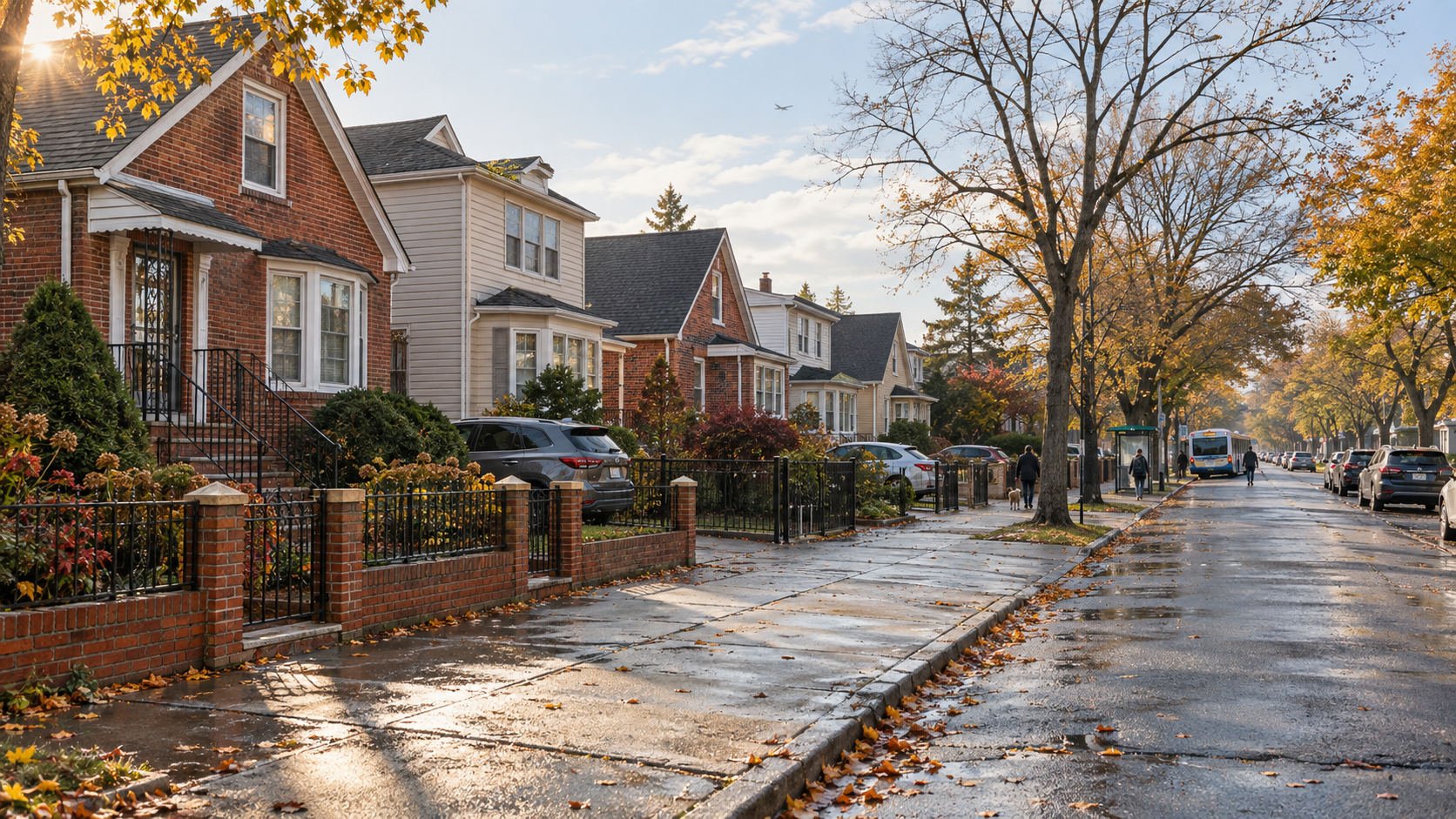
An NYC home inspection can reveal visible problems in an older Brooklyn or Queens house before those problems become your responsibility. It can identify signs of water entry, deteriorated roofing, unsafe electrical conditions, aging heating equipment and other deficiencies. It cannot see through finished walls, establish legal occupancy or guarantee that a system will not fail later. The most useful inspection is therefore not a pass-or-fail test. It is an early decision tool that helps a buyer understand the property, request specialist follow-up and discuss the contract with an attorney.
The Quick Answer: Inspect Early and Separate Three Kinds of Due Diligence
In many NYC resale transactions, the buyer schedules the inspection immediately after an accepted offer and before signing the purchase contract. Your attorney should control the legal timetable and explain any inspection contingency or cancellation right.
| Due-diligence track | Main question | Appropriate professional or source |
|---|---|---|
| Physical inspection | What visible systems or components appear deficient or unsafe today? | Licensed home inspector, architect or professional engineer |
| Specialist evaluation | What caused a concerning condition, and what repair may be needed? | Relevant engineer, roofer, electrician, plumber, mason or environmental professional |
| Legal and record review | Is the present use authorized, and are permits, violations or filings unresolved? | Real-estate attorney, architect and official NYC records |
Run these tracks together. A clean inspection report does not prove that a basement apartment is legal, and a clean Department of Buildings record does not prove that a roof is dry.
Choose a New York-Licensed Home Inspector
New York generally requires anyone performing compensated inspections of previously occupied one- to four-family residential buildings to hold a home-inspector license. Licensed and registered architects and professional engineers may also inspect within the scope of their professions. The rule and exceptions are set out in Real Property Law §444-d.
Verify the person’s current status through the New York Department of State license search. Then ask questions that a license lookup cannot answer:
- How many older Brooklyn or Queens rowhouses, detached houses and two-family homes have you inspected?
- Will you personally inspect the roof, basement or cellar, heating equipment and accessible electrical panels?
- How will you observe a flat roof if safe direct access is unavailable?
- Which environmental, sewer, chimney or pest services are excluded?
- May the buyer attend and ask questions?
- When will the written report arrive, and will it distinguish urgent defects from maintenance?
New York law requires the inspector’s license number and status on the report and requires written findings no later than five business days after the inspection. A buyer facing a faster contract schedule should agree on an earlier delivery time before hiring the inspector. RPL §444-g.
Know What the Standard Inspection Covers
New York’s standards require an inspector to report on readily accessible, visually observable systems and components. The inspection is not destructive or technically exhaustive.
| Area | Typical visual inspection | Older-house questions to raise |
|---|---|---|
| Site and drainage | Grading, walkways and conditions affecting the building | Does water move toward the foundation or collect beside the house? |
| Structure | Visible foundation, framing and structural components | Are cracks, sagging or movement signs cosmetic or worth engineering review? |
| Exterior | Walls, trim, doors, stoops, steps, porches and railings | Is brick, mortar, stone or metal deteriorating or admitting water? |
| Roof | Roofing, flashing, drains, skylights and penetrations where observable | How was the roof viewed, where does water drain and what areas were inaccessible? |
| Plumbing | Visible supply, drains, fixtures, water heating and functional flow | Are there leaks, corrosion, slow drainage or signs of older piping? |
| Electrical | Service, accessible panels, grounding and representative fixtures and receptacles | Does the apparent service and distribution suit the house and planned upgrades? |
| Heating and cooling | Fuel, equipment, controls and visible distribution | Does any condition require a heating or chimney specialist? |
| Interior and ventilation | Walls, ceilings, floors, windows, stairs and accessible attic or foundation ventilation | Do stains, odors, damaged finishes or condensation suggest recurring moisture? |
The report should identify what was observed and disclose material access limits. Furniture, stored belongings, finished surfaces, locked rooms, unsafe roofs, snow and systems that are shut down can all restrict what the inspector sees.
Start With Water: Roof, Masonry, Drainage and Basement
Water is a recurring theme in older attached, semi-detached and detached houses. Begin outside. Look at roof drainage, parapets, flashing, adjoining roof conditions, exterior masonry, window openings, stoops and the way the site drains during rain.
Inside, relate stains and repairs to what appears above or outside them. A freshly painted basement is not proof of a dry basement; neither is one dry visit. Ask about past seepage, sewer backup, sump pumps, drainage work and insurance claims through the appropriate attorney and disclosure process.
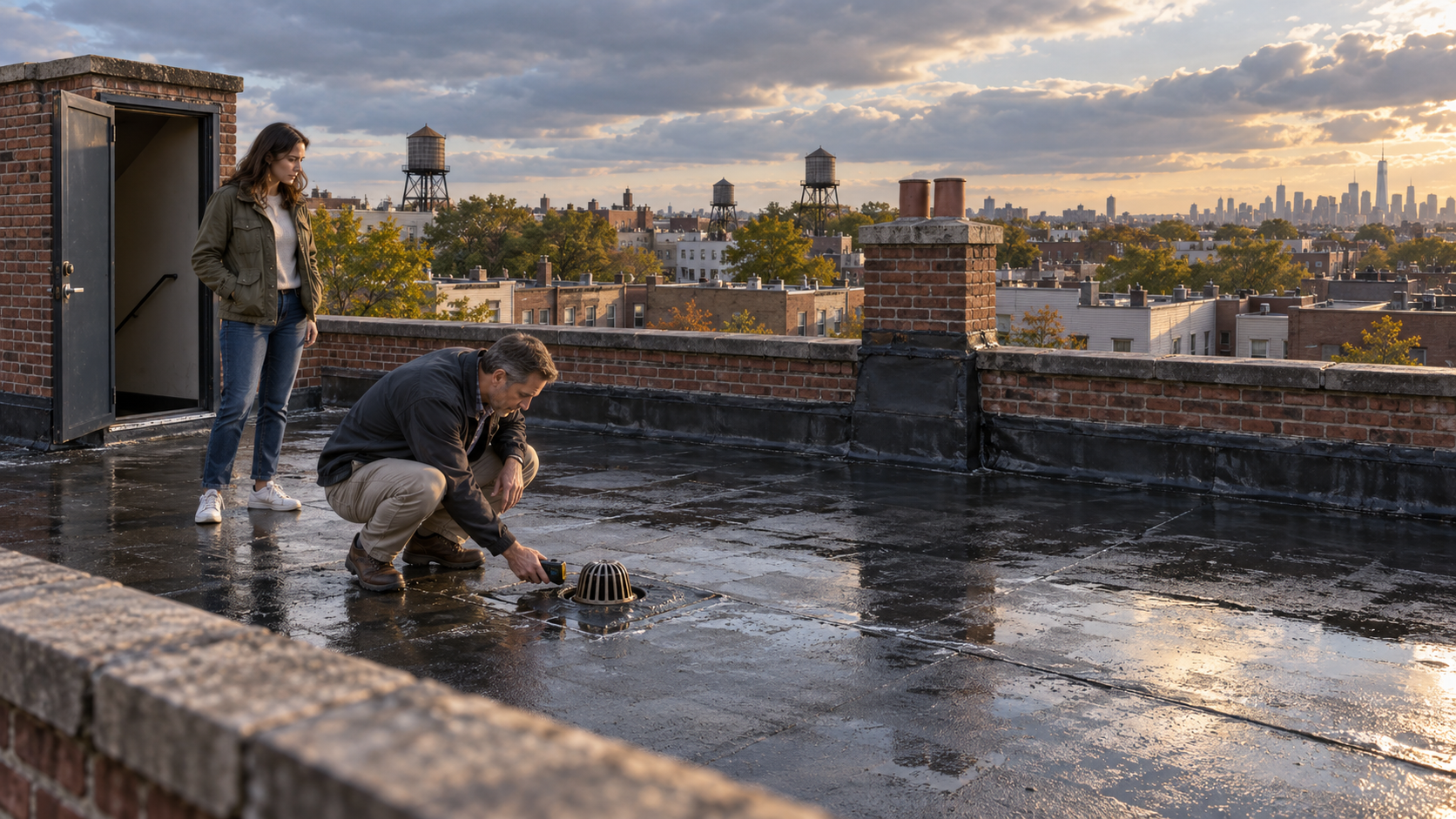
For a flat roof, the report should state how it was observed. If the inspector could view it only from the ground, a window or a neighboring level, decide whether safe access or a roofer’s evaluation is needed. An inaccessible roof is an information gap—not an automatic defect and not a reason to assume the roof is sound.
Treat Cracks and Sloping Floors as Evidence, Not a Diagnosis
Many older houses have uneven floors, patched masonry or hairline cracks. The size, pattern, location and evidence of recent movement matter more than the mere existence of a crack. A home inspector can identify visible concern and recommend further evaluation; diagnosing structural behavior or designing a repair may require a New York-licensed professional engineer or registered architect.
Escalate when the report notes significant displacement, recurring water-related movement, bowed foundation walls, materially sagging framing, altered structural members or a condition the inspector cannot confidently characterize. Do not rely on a contractor’s quick price alone when the underlying question is structural.
Give Extra Attention to Utilities and Older Alterations
An older electrical system is not deficient simply because it predates the newest equipment, but the buyer needs to know what is present. Ask the inspector to identify observable service capacity, panel conditions, grounding, overcurrent protection and representative receptacle findings.
Have a licensed electrician evaluate unsafe, damaged, improvised or materially outdated components and the load created by planned air-conditioning, induction cooking, vehicle charging or apartment separation.
For plumbing, look beyond whether a faucet runs. Functional flow, drainage, visible leakage, corrosion, water-heater condition and accessible piping all matter. A standard inspection usually does not include a camera examination of the buried house sewer. Recurring backups, slow drains, mature street trees, a visibly older trap or uncertainty about the line can justify a licensed plumber’s sewer scope.
Heating equipment should be operated using normal controls when conditions allow. Ask who maintains it, what fuel it uses and how combustion gases are vented. A chimney or heating specialist may be appropriate when the flue is inaccessible, equipment has been changed, a fireplace will be used or the inspector flags venting or safety concerns.
Order Specialist Inspections When the Evidence Supports Them
The standard inspection has deliberate limits. Use this matrix to turn uncertainty into a targeted next step.
| Finding or information gap | Possible follow-up |
|---|---|
| Significant structural movement or altered framing | Professional engineer or registered architect |
| Roof, parapet or flashing not adequately visible | Qualified roofer or masonry professional |
| Unsafe panel, damaged wiring or insufficient capacity concern | Licensed electrician |
| Slow drains, backup history or questionable buried sewer | Licensed plumber and sewer-camera scope |
| Fireplace, flue or boiler-venting uncertainty | Chimney or qualified heating specialist |
| Wood damage, droppings or suspected infestation | Appropriately licensed pest professional |
| Possible lead, asbestos, mold or environmental hazard | Qualified environmental assessor using appropriate sampling protocols |
| Clues of a former underground heating-oil tank | Tank-location or environmental specialist plus record research |
New York’s statutory definition of a home inspection excludes radon and pest inspection, and state practice standards do not require inspectors to determine whether lead, asbestos, mold, underground tanks or other environmental hazards are present. Confirm every add-on service and its scope in writing.
For most pre-1978 housing, federal rules require disclosure of known lead-based-paint information and an opportunity for the buyer to conduct a lead inspection or risk assessment before becoming bound, subject to the governing agreement. The EPA explains the buyer protections and disclosure process. A general home inspection is not a lead risk assessment.
If property history or site clues suggest a former oil tank or spill, the New York DEC environmental database includes spill incidents, remedial sites and regulated bulk-storage records. Database results need professional interpretation; absence from a database does not prove that no tank or release ever existed.
Add DOB, HPD and Flood Research Separately
A home inspector reports physical conditions, not legal compliance. Use the city’s DOB building-data tools to review available permits, applications, complaints and violations in both the Building Information System and DOB NOW.
The Certificate of Occupancy, when applicable, addresses legal use and permitted occupancy. Older buildings without a Certificate of Occupancy may require historical research rather than an assumption that the current layout is lawful.
HPD Online may show complaints, housing violations, litigation, charges or vacate orders. A complaint is not the same as a proven defect, and a closed item may still deserve context. Ask the attorney or appropriate building professional to reconcile records with the house being sold.
Flood-zone status also does not appear in a standard physical inspection. Check NYC’s official flood-map resources, including coastal risk, and the city’s stormwater guidance and map.
Discuss insurance availability, premiums, deductibles, sewer-backup coverage and any lender requirement with an insurance professional before contract if timing permits.
Do Not Substitute the Appraisal for an Inspection
| Home inspection | Lender appraisal |
|---|---|
| Commissioned primarily for the buyer’s condition due diligence | Commissioned primarily for the lender’s collateral analysis |
| Examines readily observable systems and components | Develops an opinion of value and checks lender-specific property concerns |
| Can recommend specialist evaluation | Does not provide a complete systems inspection |
| Does not determine market value | Does not protect the buyer from every physical defect |
The New York Attorney General advises buyers to obtain an independent inspection and not rely on the lender’s appraisal. Financing approval is not a condition warranty.
Turn the Report Into a Purchase Decision
Read the complete report, not only its summary page. Sort findings into three groups:
- Safety or active-damage concerns: Conditions requiring prompt professional attention, such as active leakage, unsafe electrical findings or suspected structural instability.
- Near-term capital items: Aging roof, heating, masonry, drainage or other work that may affect the first years of ownership.
- Routine maintenance and observation: Ordinary repairs, service needs and conditions to monitor.
Obtain specialist opinions or estimates for items that could materially change the decision. Then discuss the available contract response with the attorney.
Depending on timing, seller interest, financing and the proposed agreement, a buyer might proceed as offered, request a price change or credit, ask for a defined repair or decide not to continue. An inspection does not guarantee that the seller must renegotiate.
If the seller completes material work, preserve permits, paid invoices and warranties and consider an appropriate reinspection. A receipt shows that someone was paid; it does not by itself establish that the original condition was fully corrected.
Inspect the House You Are Actually Prepared to Own
Older Brooklyn and Queens houses often combine durable construction with decades of repairs, additions and changing mechanical systems. The goal is not to eliminate every imperfection. It is to understand the visible condition, identify questions that require specialists and calculate whether the likely work fits your ownership plan.
Use the Queens two-family buying guide when rental units or legal use are part of the purchase. Before signing, also include the NYC contract deposit and buyer closing costs in the same decision.
Sheldon Myers, Licensed Associate Broker, can help buyers compare older houses, arrange access for appropriate inspections and coordinate property questions with the buyer’s attorney and specialists. Request a Brooklyn or Queens buyer consultation.
Serving Brooklyn and Queens buyers and property owners since 2004.
This article provides general real-estate information, not legal, engineering, architectural, environmental, insurance or inspection advice. Inspection scope, property conditions, contract rights and official records vary. Use appropriately licensed professionals and consult your own New York real-estate attorney before signing a contract or acting on a report.