
Buying a Home in South Ozone Park, Queens
Buying a home in South Ozone Park requires more than deciding whether a listing has the right bedroom count or asking price. The neighborhood contains different house styles, transit patterns and block conditions, while the legal use, flood exposure and building history can vary from one address to the next. A property may be marketed as a one-family, two-family or home with “extra space,” but buyers should verify what the records actually permit. The strongest approach combines an in-person block review with official records, a professional inspection and attorney-led due diligence before contract.
The short answer: evaluate the address, not just the neighborhood name
“South Ozone Park” is useful for searching, but it does not answer the questions that determine whether a particular home fits your plans. Listing boundaries can be informal, and homes a few blocks apart may offer different transportation, traffic, housing layouts and exposure to heavy rain.
Use this address-level framework:
| Question | Why it matters | What to verify |
|---|---|---|
| What is the legal property type? | It affects occupancy, financing, rental-income analysis and future plans | Certificate of Occupancy, approved plans and other DOB records |
| How will you actually travel? | A subway icon on a listing may hide a bus transfer or long walk | Door-to-door route at the times you normally commute |
| Is the lower level vulnerable to water? | Coastal and intense-rain risks are different | FEMA, NYC coastal-flood and NYC stormwater maps, plus physical inspection |
| Does the layout match the records? | Kitchens, bedrooms and separate entrances do not establish legal use | DOB records and, when needed, attorney or architect review |
| Does the block fit daily life? | Parking, road noise, commercial activity and drainage are highly localized | Multiple visits, including rush hour, evening and after rain |
No single database replaces professional due diligence. The value comes from comparing the listing, the physical house and the public records until they tell the same story.
Understand the property types you may encounter
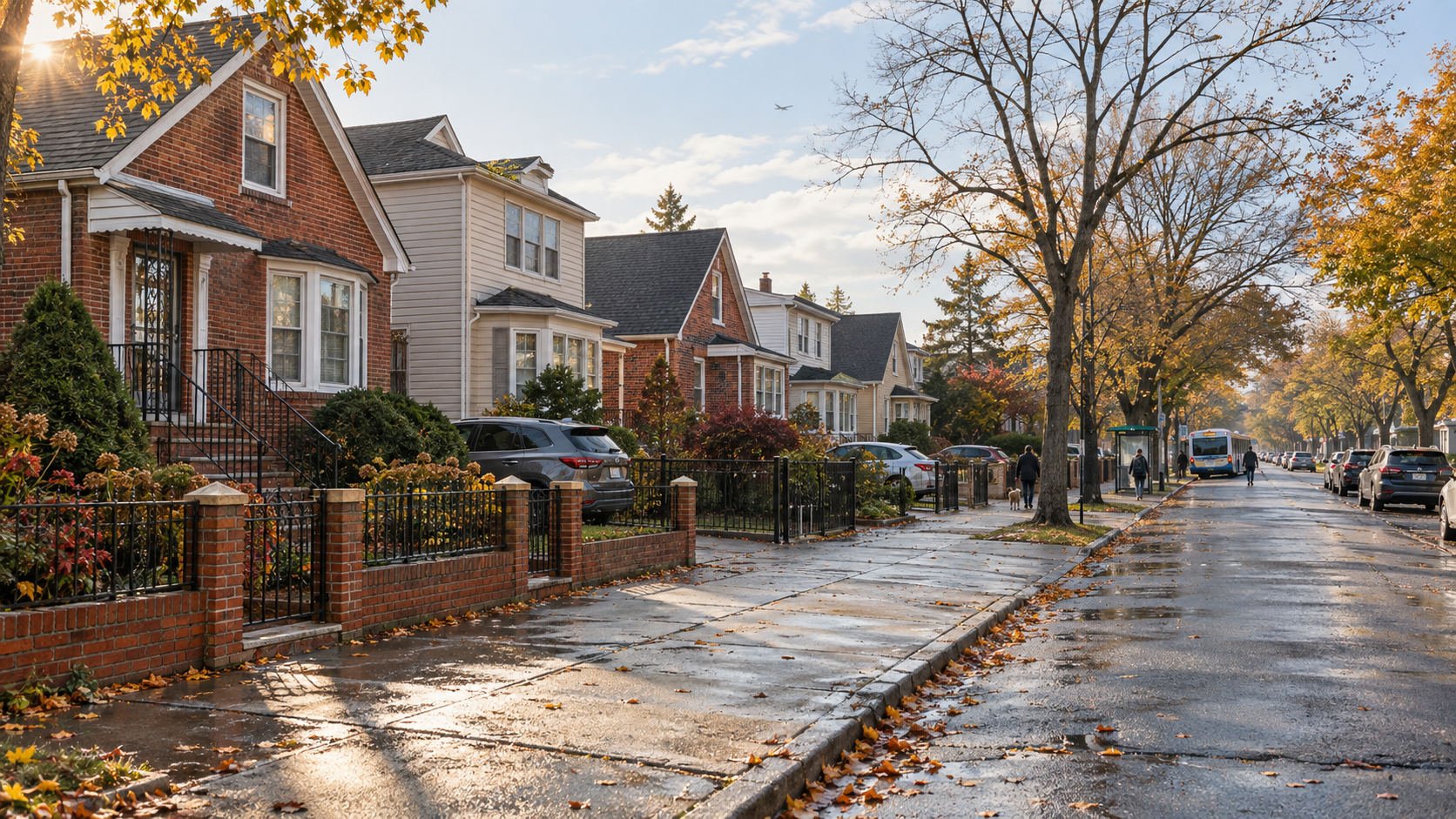
South Ozone Park buyers commonly encounter detached and semi-detached one-family houses, two-family homes, attached houses and small multifamily properties. Inventory varies by block, and a listing description should be treated as a starting point rather than proof of lawful occupancy.
One-family homes
A one-family house may appeal to a buyer who wants the whole building for one household. Review additions, converted garages, enclosed porches and finished lower levels carefully. Renovated space can be attractive without necessarily being approved as a bedroom, apartment or separate dwelling unit.
Two-family homes
A legal two-family house can offer an owner-occupant the possibility of rental income, but the lender decides how much documented income it will count. Confirm the legal unit count, leases, rents, utility arrangement and which unit—if either—will be delivered vacant. A second kitchen or doorbell is not proof that the second unit is lawful.
The seller-focused guide to Queens two-family houses explains why occupancy, documented rent and legal use can change the likely buyer pool.
Attached or semi-detached houses
With an attached house, inspect party-wall areas, roof transitions and any shared structural or drainage conditions. With a semi-detached or detached home, pay close attention to side-yard access, lot lines, retaining walls and exterior maintenance. A narrow driveway or shared driveway should be measured and reviewed rather than assumed to work for a particular vehicle.
Small multifamily or mixed-use properties
These can involve different financing, insurance, appraisal and tenancy questions from a typical one- or two-family home. If a storefront, office or additional unit is present, confirm the permitted use and obtain professional advice early.
Treat transportation as a door-to-door question
South Ozone Park is not one uniform walk-to-subway market. The nearby A line serves Ozone Park–Lefferts Boulevard, while many addresses rely on a local bus, a transfer, driving or some combination. Current MTA routes serving or connecting the area include the Q9 between Jamaica and South Ozone Park, the Q37 between Kew Gardens and South Ozone Park and the QM18 express route to Midtown. Service patterns can change, so use the current MTA trip planner for the exact address and travel time.
Test the trip instead of relying only on a map:
- Start at the front door during your normal morning travel window.
- Time the walk to the stop, the wait, the transfer and the complete trip.
- Repeat the trip in the evening or on a weekend if those times matter.
- Check the return route, because the stop or service pattern may differ.
- Consider late-night frequency and accessibility if either is important to your household.
Proximity to major roads or JFK Airport may be useful for some buyers, but traffic and aircraft noise are block- and time-dependent. Visit when you expect to be home, pause outside, and listen with the windows open inside the property.
Visit the block more than once
An open house gives only a short snapshot. Return without the listing agent and observe the area at different times. A useful block review includes:
- Traffic and horn noise during weekday rush hours
- Parking availability after residents return home
- Bus, truck and airport-related traffic
- Nearby commercial, school or house-of-worship activity
- Street lighting and pedestrian activity after dark
- Curb cuts, hydrants and posted parking restrictions
- Standing water, clogged catch basins or low points after rain
- Nearby construction, vacant lots or visibly active renovation work
- The actual walk to transit, shopping and other regular destinations
These observations are not reasons to label a block “good” or “bad.” They help determine whether its real conditions match your routine and priorities.
Check both coastal and stormwater flood information
Flood due diligence should be address-specific. Start with the FEMA Map Service Center, the official source for National Flood Insurance Program map products. Then compare the address with New York City’s flood-hazard and stormwater resources. FEMA maps are important for current insurance and lending questions, while city tools can add context about coastal hazards and heavy-rain scenarios.
A property outside a mapped high-risk FEMA flood area can still experience water from intense rainfall, poor drainage, sewer backup or site conditions. Before committing:
- Request an insurance quote using the exact address and intended occupancy.
- Ask whether the lender will require flood insurance.
- Inspect the basement or cellar for staining, efflorescence, fresh paint, odors and damaged finishes.
- Ask about prior water entry, claims, pumps, backflow devices and drainage work.
- Examine exterior grading, drains, gutters and downspout discharge.
- Hire a qualified home inspector to evaluate visible conditions and recommend specialists when warranted.
Do not assume a renovated lower level is dry or legally habitable because it looks finished. Water risk and legal occupancy are separate questions, and both need answers.
Compare the physical layout with DOB records
The NYC Department of Buildings property-data tools can show Certificates of Occupancy, permit applications, complaints, violations and other building history. A Certificate of Occupancy identifies a building’s legal use and permitted occupancy. Some buildings constructed before 1938 may not have one unless later work changed the use, egress or occupancy; in an appropriate case, a Letter of No Objection or historical record review may be relevant.
Check whether the official records support:
- The stated number of dwelling units
- Extensions, dormers and enclosed porches
- Garage conversions or removal
- Decks, curb cuts and significant structural work
- Plumbing or electrical work tied to a second kitchen
- The claimed use of a basement, cellar or attic
Open violations or applications do not all carry the same consequence, and an online record may be incomplete or require interpretation. Let your New York real-estate attorney review the transaction documents and title issues. If use, layout or construction is uncertain, involve an architect, engineer or other appropriate professional before contract.
The city’s ZoLa map is useful for viewing zoning, lots and related land-use information, but zoning potential does not prove that existing work is legal. Likewise, the absence of a visible complaint does not prove every alteration was approved.
Review title, tax and ownership records
New York City’s ACRIS system provides access to recorded deeds, mortgages and other property documents for Queens. Buyers can use it for preliminary research, but their attorney’s title examination is the transaction-level safeguard. Easements, judgments, liens, ownership questions and boundary matters should not be resolved from a casual online search.
Also review the Department of Finance property record and tax bills. Confirm the tax class, assessed value, exemptions and current charges. An exemption associated with the seller may not continue for the buyer, so do not calculate future ownership cost by copying one number from a listing.
Obtain insurance estimates before contract when possible, particularly for a property with an older roof, prior claims, multifamily occupancy or a finished lower level. Ask which utilities serve each unit and who pays for heat, hot water, electricity and water. A lower purchase price can be offset by insurance, repair and operating costs that were not evaluated early.
Verify school information by exact address
If public-school access matters, use the NYC Public Schools Find a School tool with the exact home address. Do not rely only on a listing, a third-party map or the nearest school building. Zones, programs, eligibility and available seats can differ, and no real-estate listing should be treated as an enrollment guarantee.
Keep school research factual and personal to your needs. Visit official school pages, review current enrollment guidance and contact NYC Public Schools directly when a placement question could affect the purchase.
Coordinate your offer with due diligence
Once a property fits your budget and block-level criteria, align the offer with the information you still need. The guide to making an offer on a house in NYC explains price, financing, contingencies and seller priorities. After an accepted offer, move promptly on attorney review and the NYC home inspection.
Your lender will order an appraisal, but an appraisal is not a substitute for an inspection, title review or legal-use analysis. If the valuation comes in below the contract price, the guide to a low appraisal in NYC outlines the main options.
The goal is not to eliminate every uncertainty. It is to identify the issues that affect safety, lawful use, monthly cost, financing and resale before your negotiating position narrows.
Make the neighborhood search specific to you
South Ozone Park offers a range of houses and transportation patterns, but the right choice depends on the actual property and how you plan to use it. Start with the legal unit count, test the real commute, inspect the lower level, review flood and building records, and return to the block at different times. That address-level work is more useful than a broad neighborhood label or a generic ranking.
Request a South Ozone Park buyer consultation to build a property search around your housing type, commute, budget and due-diligence priorities.
Sheldon Myers
Licensed Associate Broker, LJ Realty Team
Serving Brooklyn and Queens buyers and property owners since 2004.
This article provides general real-estate information, not legal, lending, insurance, engineering, environmental, flood-zone or school-placement advice. Rules, maps, service patterns and property records can change. Consult the appropriate qualified professionals about a specific property.