Buying a Co-op in Queens: 2026 Guide
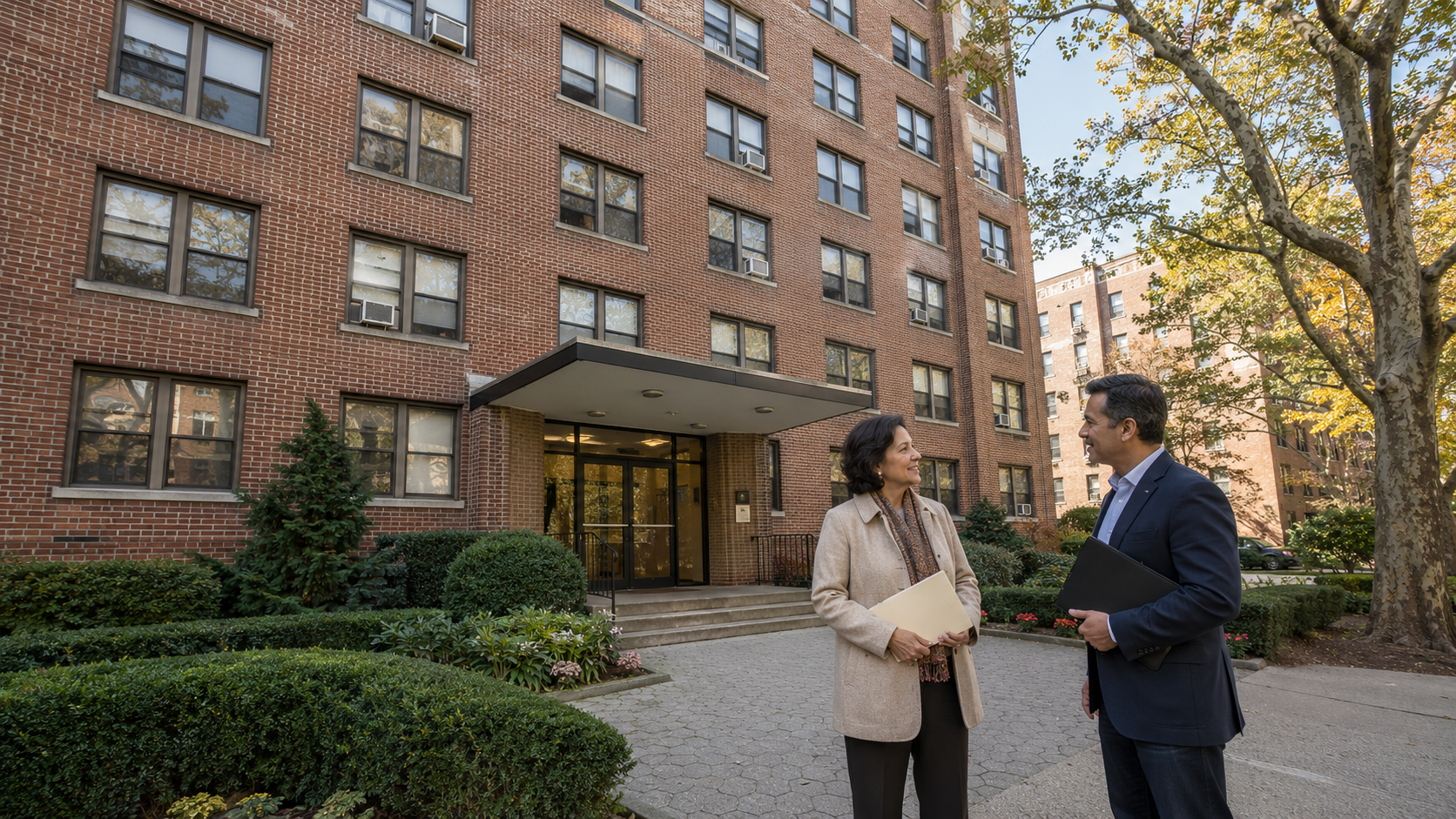
Buying a co-op in Queens means evaluating two things at once: the apartment you want and the corporation that owns the building. Your lender will review your income and assets, but it may also examine the co-op’s budget, insurance, reserves and underlying debt. The board then reviews a separate purchase application. Since July 28, 2026, many NYC co-ops with at least 10 apartments must follow new deadlines for acknowledging and deciding applications. A strong purchase plan therefore starts with building due diligence—not with the board package alone.
The Quick Answer: Investigate the Building Before Seeking Approval
The usual sequence is:
| Stage | Main buyer task | What can hold it up |
|---|---|---|
| Accepted offer | Confirm price, financing structure and intended occupancy | Deal terms are not yet a signed contract |
| Attorney review | Examine the contract, offering plan, amendments, proprietary lease and building records | Missing minutes, financials, litigation or building disclosures |
| Contract and deposit | Sign after legal advice and deliver the agreed deposit | Deposit amount, financing contingency and board-rejection terms |
| Loan and project review | Complete personal underwriting while the lender evaluates the co-op | Building finances, insurance, owner occupancy or underlying debt |
| Board package | Submit every requested item in the required format | Inconsistent figures, missing pages, references or lender documents |
| Board decision | Track the statutory clock if Local Law 58 covers the co-op | Incomplete submissions, a lawful extension or summer recess |
| Closing | Satisfy lender, attorney and managing-agent conditions | Final loan clearance, lien search, recognition agreement and scheduling |
Several stages overlap. Board approval is important, but it is not the same as loan approval or permission to close.
Understand What a Co-op Buyer Actually Purchases
In a cooperative, the corporation owns the building. The purchaser buys shares allocated to an apartment and receives the right to occupy it through a proprietary lease. The New York Attorney General’s co-op overview explains this structure and why monthly maintenance is tied to shares rather than a deeded unit.
That distinction affects due diligence, financing and closing. The corporation can have an underlying mortgage, building-wide obligations and rules governing sublets, renovations, pets, occupancy and transfers. A beautiful apartment does not offset a problem in the corporation’s finances or governing documents.
Review the Offering Plan and Amendments Before Contract
The New York Attorney General recommends that a prospective purchaser read the entire offering plan and consult an attorney before signing a purchase agreement. For a resale, the original plan may be old; amendments, financial statements, minutes and current governing documents show what has changed.
Ask your attorney which records are available and material, including:
- The offering plan and all relevant amendments
- Proprietary lease, bylaws and house rules
- Recent audited financial statements and the current operating budget
- Recent board or shareholder meeting minutes
- The building’s insurance information
- The underlying mortgage balance, interest terms and maturity date
- Current maintenance, assessments and any announced increases
- Reserve balances and planned capital projects
- Pending litigation, major claims or regulatory issues
- Sublet, alteration, pet and primary-residence rules
- Sponsor-owned or unsold shares and commercial-space obligations
- Any ground lease, tax abatement or unusual income source
The Attorney General’s offering-plan database can help identify a plan, amendments, sponsor information and the agency file number. It is a research starting point, not a substitute for the documents and attorney review.
Read the Building Financials as a Future Shareholder
You are not trying to find a building with no expenses. You are trying to understand whether current maintenance, reserves and future obligations fit your budget.
| Item to examine | Question it helps answer |
|---|---|
| Operating results | Is recurring income generally covering recurring expenses? |
| Cash and reserves | Can the co-op absorb repairs without an immediate large assessment? |
| Capital plan | Are façade, roof, elevator, boiler or other major projects approaching? |
| Underlying mortgage | When does it mature, and could refinancing change maintenance? |
| Assessments | What is owed, when does it end, and can another assessment follow? |
| Shareholder arrears | Is a meaningful portion of expected maintenance going uncollected? |
| Insurance and claims | Is coverage adequate for the building and lender? |
| Ground lease or abatement | Could a reset or expiration materially change monthly costs? |
| Sponsor and sublet concentration | Could ownership patterns affect governance, financing or resale? |
None of these is automatically a reason to walk away. A well-planned assessment may be healthier than years of deferred work, and a large reserve can still be inadequate for an unusually expensive project. Ask what changed, what is funded and how the issue affects your monthly payment, financing and eventual resale.
Lender standards add another screen. Fannie Mae’s current co-op guidance asks lenders reviewing eligible projects to examine budgets, financial statements or tax returns, reserves, delinquency, insurance, sponsor control and other building-level risks. Its detailed thresholds are loan-program rules, not universal definitions of a “good” co-op. A different lender or loan type may reach a different result.
Ask the lender early whether it has recently financed in the building and whether it needs a project questionnaire, financials, insurance documents or managing-agent responses. A personal preapproval does not mean the apartment or building has passed project review.
Build a Board Package That Tells One Consistent Financial Story
The managing agent or board should provide the current application and transfer requirements. A typical resale package may request:
- The signed application and purchase contract
- A detailed personal financial statement
- Bank, brokerage and retirement-account statements
- Recent tax returns and income documentation
- Employment verification
- Loan commitment or other financing documents
- Personal, professional or landlord reference letters
- Identification, acknowledgments, authorizations and required fees
- Evidence of funds remaining after closing, when required
Requirements differ by building. Use the exact checklist, order, file names, page limits and delivery method provided. Do not reuse an old package from another listing.
Before submission, reconcile the purchase price, down payment, loan, income, assets, liabilities and occupancy plan across the contract, lender file and application. Explain legitimate large transfers, gifts or one-time income through the appropriate lender or attorney channel. Never alter a statement or omit a liability to make the numbers look stronger.
If references are required, give each writer the deadline and stated format. Submit sensitive records through the building’s approved secure process and retain dated proof of every delivery. Under the new deadline law, the submission date and completeness response matter.
Use NYC’s New 15-Day and 45-Day Co-op Timeline
NYC Local Law 58 of 2026 applies to covered purchase applications made on or after July 28, 2026. It generally covers co-op corporations with at least 10 dwelling units. Co-ops with fewer than 10 units, Housing Development Fund Company co-ops and entities whose transfers require government housing-agency approval are excluded.
For a covered application:
- The co-op must maintain standardized application and transfer requirements and provide them promptly upon request.
- Within 15 days after the initial submission—and after a later submission responding to missing items—it must state by email and registered mail whether the package is complete.
- If incomplete, the notice must identify every missing item and point to the relevant application requirement. If the co-op does not acknowledge the submission on time, the package is deemed complete when the acknowledgment was due.
- Within 45 days after the application is complete or deemed complete, the co-op must notify the buyer or buyer’s agent by email that consent is granted, granted with stated conditions or denied.
The buyer may agree to an extension in writing. A co-op can also take one extension of no more than 14 days without the buyer’s consent if it gives timely notice. Properly announced July or August board recesses may toll the applicable periods.
The law creates a decision schedule; it does not guarantee approval. It also does not generally require a detailed explanation for an ordinary denial. Send any missed-deadline, deemed-complete or contract-rights dispute to the attorneys rather than trying to resolve it through the board interview.
Prepare for the Interview Without Changing Your Application
If the building requests an interview, review your submitted package, proprietary lease and house rules beforehand. Be ready to discuss your intended occupancy and any lawful application questions. Keep answers accurate and consistent; the interview is not the time to introduce a different financing plan, undisclosed occupant or renovation promise.
Boards, sellers, brokers and managing agents remain subject to fair-housing law. NYC’s Fair Chance Housing guidance also limits when most covered housing providers may seek or consider criminal-history information and requires a specific process if they choose to do so. Those rules are separate from Local Law 58’s general application timetable.
Protect the Deposit and Closing Plan in the Contract
Before signing, ask your attorney to explain the financing contingency, board-approval condition, deadlines, default provisions and what happens to the contract deposit if the board denies the application or the lender rejects the building. This guide to the NYC contract deposit explains why it is different from the mortgage down payment.
Budget beyond the down payment. A co-op buyer may face attorney, lender, appraisal, lien-search, managing-agent, application, move and building charges, plus prepaid maintenance or escrow requirements. Use the NYC buyer closing-cost guide to create a cash-to-close estimate.
If assistance is part of the plan, confirm that the program, lender and co-op are compatible before contract. See the guide to NYC first-time homebuyer programs.
Choose the Building as Carefully as the Apartment
The best Queens co-op purchase is not simply the nicest renovated unit. It is an apartment, building and approval path that work together: affordable monthly charges, understandable capital needs, acceptable governing rules, viable financing and a complete application.
Sheldon Myers, Licensed Associate Broker, can help buyers compare Queens co-op listings, investigate building-specific purchase requirements and coordinate the search with the buyer’s attorney and lender. Request a Queens co-op buyer consultation.
Serving Brooklyn and Queens buyers and property owners since 2004.
This article provides general real-estate information, not legal, lending, financial, tax or fair-housing advice. Co-op requirements and financing depend on the building, governing documents, contract, buyer, lender and current law. Consult a qualified New York real-estate attorney and appropriate lending and financial professionals before signing a contract or relying on an approval timeline.