Selling a Co-op in Queens: Board Requirements, Fees and Closing Timeline
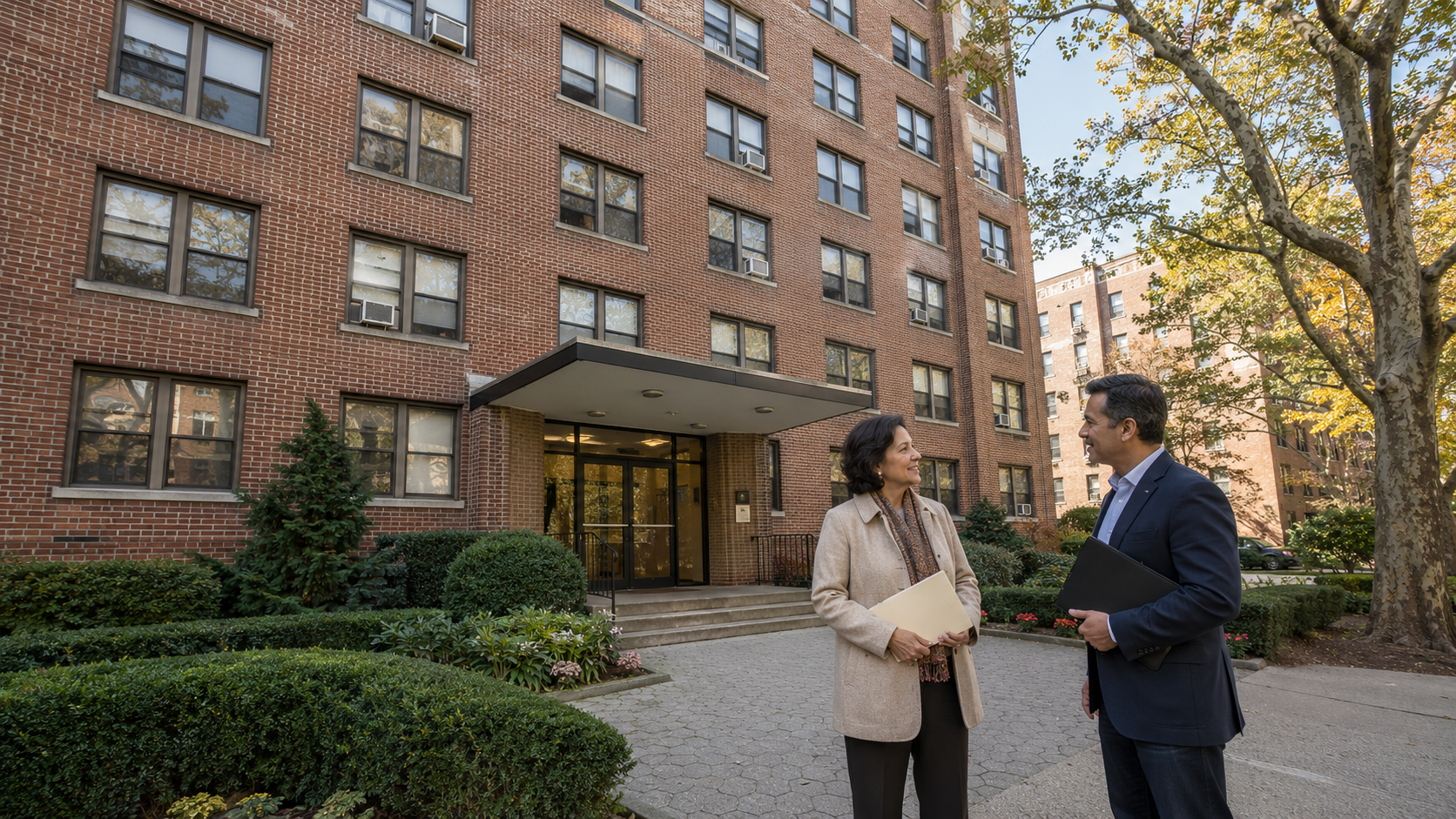
Selling a co-op in Queens involves more than finding a buyer and agreeing on a price. The transaction transfers shares in a cooperative corporation and the accompanying proprietary lease—not a deed to an individual apartment. The buyer may need both lender approval and board consent, while the seller must satisfy the building’s transfer rules, clear any share loan and budget for building-specific fees. New York City also introduced enforceable application timelines in July 2026 for many co-ops with at least 10 apartments. A successful sale therefore depends on three files moving together: the contract and legal work, the buyer’s financing, and a complete board package.
The quick answer: prepare the building file before listing
Obtain the current transfer package and fees, locate the stock and lease, compare offers for financial execution as well as price, and remember that board approval does not by itself make the transaction ready to close. Building-specific requirements control.
Understand what the seller is transferring
The New York Attorney General explains that a purchaser buys shares and receives occupancy rights through a proprietary lease. The seller ordinarily needs the original stock certificate and lease, plus details of any lender holding them. Fannie Mae’s requirements illustrate the lender’s interest in those documents. Report a missing original early because replacement procedures are building-specific.
Request the current resale package and fees
Before photography or the first open house, ask the managing agent for:
- The current purchase application and transfer requirements
- Disclosed financial criteria, financing limits and recognition-agreement procedures
- The proprietary lease, bylaws, house rules, available amendments and building financials
- Current maintenance, assessments and arrears for the apartment
- Every application, transfer, flip-tax, closing and move-out charge
- Any inspection, alteration-closeout, move-scheduling or summer-recess rule
Confirm which documents may be shared before contract and which are delivered through counsel. The existing NYC home-sale document checklist explains where co-op ownership papers fit within the broader seller file.
Evaluate more than the offered price
A co-op seller does not decide board approval, but can compare offers using consistent, lawful factors: proof of funds, down payment, financing contingency, lender status, timeline and whether the buyer has accounted for the building’s disclosed financial standards. Cash removes lender underwriting, not board review. A preapproval does not establish that the lender has approved the building or completed underwriting.
Housing decisions remain subject to fair-housing laws. Sellers, brokers and boards cannot use protected personal characteristics unlawfully. The New York Attorney General explains the applicable protections and complaint routes.
Know the new NYC co-op board deadlines
New York City Local Law 58 of 2026 applies to covered applications made on or after July 28, 2026. It generally covers cooperative corporations with at least 10 dwelling units. It excludes Housing Development Fund Company co-ops, buildings with fewer than 10 units, and entities whose transfers require approval by a government housing agency.
For a covered application:
- The co-op must provide its application and transfer requirements promptly upon request.
- Within 15 days after an initial or subsequent submission, it must acknowledge the materials by email and registered mail, state whether the application is complete and identify missing items.
- If it fails to provide that acknowledgment on time, the application is treated as complete on the date the acknowledgment was due.
- Within 45 days after a complete—or deemed complete—application, it must notify the purchaser or the purchaser’s agent by email whether consent is unconditional, conditional or denied.
The purchaser may agree in writing to an extension. The co-op may also take one extension of no more than 14 days without consent if timely notice is given; a documented summer recess can toll July or August deadlines.
The law creates a timetable, not automatic approval. A board may still lawfully deny or condition consent, and other transaction work can continue after its decision. HPD enforces violations through civil penalties; send a deadline dispute to the attorneys.
Make the board package internally consistent
Requirements vary, but a purchaser’s package may include:
- The signed contract and completed application
- A financial statement and recent asset statements
- Tax returns and income verification
- References and proof of post-closing funds
- Loan or commitment documents
- Required authorizations, acknowledgments and fees
The listing agent organizes the process but cannot alter financial information or predict approval. Names, assets, price, financing and occupancy plans should remain consistent across the contract, lender file and application. Follow the building’s redaction instructions and keep dated proof of every submission because the completeness acknowledgment starts the decision period.
Put every co-op charge on the seller net sheet
Co-op expenses are not limited to brokerage and legal fees.
| Cost or deduction | What to confirm |
|---|---|
| NYC Real Property Transfer Tax | 1% at $500,000 or less; 1.425% above $500,000 for an individual co-op apartment |
| New York State transfer tax | Generally 0.4%, with an additional state base tax for qualifying NYC residential transfers of $3 million or more |
| Flip tax or building transfer fee | Formula, payer and payment date in the governing documents and contract |
| Managing-agent and move charges | Application, processing, lien-search, transfer-agent, elevator, deposit and closing fees |
| Share-loan payoff | Principal, interest, lender fees and documents needed to release its security interest |
| Maintenance, assessments and documents | Arrears, adjustments, assessment balances and any replacement-certificate or lease expense |
The NYC Department of Finance includes individual co-op apartments in its residential category, while the New York State Tax Department explains state rates. A flip tax is a building charge, not a government tax; its formula may use price, profit, shares or another method.
Use the broader NYC seller closing-cost guide to build the rest of the net sheet. Capital-gains consequences depend on the seller’s facts and belong with a tax adviser.
Plan a co-op-specific closing timeline
These phases overlap, so do not simply add every range:
| Phase after accepting an offer | Practical planning range |
|---|---|
| Attorney review and contract signing | About 1–3 weeks |
| Financing and board-package preparation | About 2–5 weeks, often overlapping |
| Completeness acknowledgment for a covered co-op | Within 15 days of each submission |
| Board decision after completeness | Within 45 days, subject to lawful extensions and recess tolling |
| Final payoff, clearance and closing coordination | Commonly 1–3 weeks after all approvals and conditions are ready |
A prepared financed transaction may take roughly 8–16 weeks from accepted offer to closing; missing documents, unusual financing, estate authority or a summer recess can take longer. These ranges are not promises. The NYC home-sale timeline explains the broader stages.
Board approval is not the closing. The attorneys, lender, transfer agent and managing agent must still coordinate the payoff, searches, tax filings, adjustments, original documents, financing papers and appointment. See what happens after accepting an offer in NYC for the surrounding handoffs.
Treat restricted co-ops as a separate sale type
An HDFC or government-supervised co-op may have income limits, resale restrictions, agency approval and a specialized flip tax. NYC HPD’s HDFC guidance directs shareholders to the governing documents and regulatory agreements. Do not assume a market-rate comparable or Local Law 58 applies.
Start with the building, then price the apartment
Similar Queens apartments can produce different proceeds and timelines because their maintenance, assessments, financing rules, flip taxes and board processes differ. Obtain the building file, price against comparable co-op sales and evaluate both value and likelihood of closing.
Sheldon Myers, Licensed Associate Broker, can help Queens shareholders compare recent co-op sales, prepare the listing and screen transaction terms against the building’s disclosed requirements while legal advice remains with the parties’ attorneys. Request a Queens co-op sale-readiness consultation.
Serving Brooklyn and Queens property owners since 2004.
This article provides general real-estate information, not legal, tax, lending or fair-housing advice. Co-op requirements depend on the governing documents, managing agent, contract, financing, building type and current law. Consult a qualified New York real-estate attorney and tax or lending professionals about a specific transaction.